
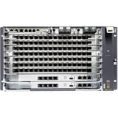
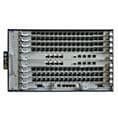
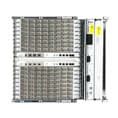
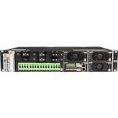


In the world of fiber-optic communication, the OLT (Optical Line Terminal) serves as the “brain” of the entire Passive Optical Network (PON). If you are building a Fiber-to-the-Home (FTTH) or Fiber-to-the-Business (FTTB) network, understanding the OLT is critical for ensuring high-speed, reliable connectivity.
1. What is an OLT?
An Optical Line Terminal (OLT) is the central endpoint hardware in a PON architecture. Positioned in the Service Provider’s Central Office (CO), it acts as the interface between the core network (the Internet) and the end-users.
Key Functions of an OLT:
Signal Conversion: Converts the electrical signals from the provider’s equipment into optical signals used by the fiber network.
Traffic Management: Coordinates the multiplexing of data between the conversion devices (ONT/ONU) at the customer’s premises.
Bandwidth Allocation: Dynamically assigns bandwidth to users to ensure stable performance.
Control & Maintenance: Manages the ranging, authentication, and security of all connected subscribers.
2. Huawei vs. ZTE: The Giants of the OLT Market
When it comes to carrier-grade reliability, Huawei and ZTE dominate the global ISP landscape. While both offer high-performance solutions, they cater to slightly different network philosophies and budgets.
Huawei OLT: The Performance Leader
Huawei’s SmartAX MA5800 series is the industry’s first distributed architecture OLT. It is designed to handle “Ultra-Broadband” requirements, including 4K/8K video and VR.
-
Best for: Large-scale ISPs, high-density urban areas, and future-proofing for XGS-PON.
ZTE OLT: The Flexibility Champion
ZTE’s ZXA10 series is renowned for its modularity and cost-effectiveness. Their “TITAN” platform (C600 series) provides excellent multi-service integration.
-
Best for: Budget-conscious projects, phased network expansions, and multi-vendor interoperability.
3. Best-Selling OLT Models Comparison
The following table compares the most popular models currently used by ISPs worldwide:
| Feature | Huawei MA5800-X7 | ZTE ZXA10 C600 | Huawei MA5608T | ZTE ZXA10 C320 |
| Capacity | Large (6U) | Large (11U) | Small (2U) | Small (2U) |
| Architecture | Distributed | Fully Distributed | Centralized | Centralized |
| Max PON Ports | 112 (GPON) | 224 (GPON) | 32 (GPON) | 32 (GPON) |
| Next-Gen Ready | XGS-PON / 50G PON | XGS-PON / 50G PON | GPON / 10G PON | GPON / 10G PON |
| Primary Use | Metro Core | National Carrier | Rural/Enterprise | Small ISP/MDU |
4. Key Differences: Which One Should You Choose?
Scaling and Architecture
-
Huawei MA5800 uses a distributed architecture, meaning the data processing is handled on the service boards rather than just the control board. This eliminates bottlenecks as your subscriber base grows.
-
ZTE C600 (TITAN) focuses on high-density integration, offering a massive number of ports in a single chassis, which is ideal for massive urban deployments.
Software and Interoperability
-
Huawei has a very “closed-loop” ecosystem. While their NMS (Network Management System) is powerful, it works best with Huawei-branded ONTs.
-
ZTE is often cited as having better third-party interoperability, making it easier to mix and match different brands of ONTs/ONUs on the same line.
Total Cost of Ownership (TCO)
-
ZTE generally offers a more competitive initial purchase price.
-
Huawei may have a higher upfront cost but often provides lower long-term maintenance costs due to its superior energy efficiency and hardware stability.
Conclusion: Setting Up Your Fiber Future
Choosing between a Huawei or ZTE OLT depends on your specific growth plans. If you are looking for the absolute cutting edge of distributed processing, the Huawei MA5800 is the gold standard. If you need a flexible, high-capacity platform with a faster ROI, the ZTE C600 is a powerhouse.