
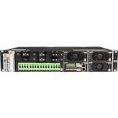

In telecom infrastructure, providing stable -48V DC power is as critical as the data itself. The Huawei ETP4860 series has become the go-to solution for powering OLTs (like the MA5800) and transmission devices.
However, many engineers struggle to choose between the ETP4860-B1A1 and the ETP4860-B1A2. While they look nearly identical, their internal distribution and monitoring capabilities set them apart.
1. Core Similarities: The 60A Powerhouse
Both models are 1U-high embedded power systems designed for 19-inch racks. They share the same high-efficiency DNA:
-
Max Output: 60A (Total 4000W when using two R4830G rectifiers).
-
Input Flexibility: Support both 220V AC/110V AC and High-Voltage DC (HVDC).
-
Rectifier Compatibility: Usually equipped with two R4830G (30A) or R4815G (15A) hot-swappable modules.
-
Efficiency: Rectifiers reach up to 96% efficiency, significantly reducing heat and power loss.
2. The Critical Differences: B1A1 vs. B1A2
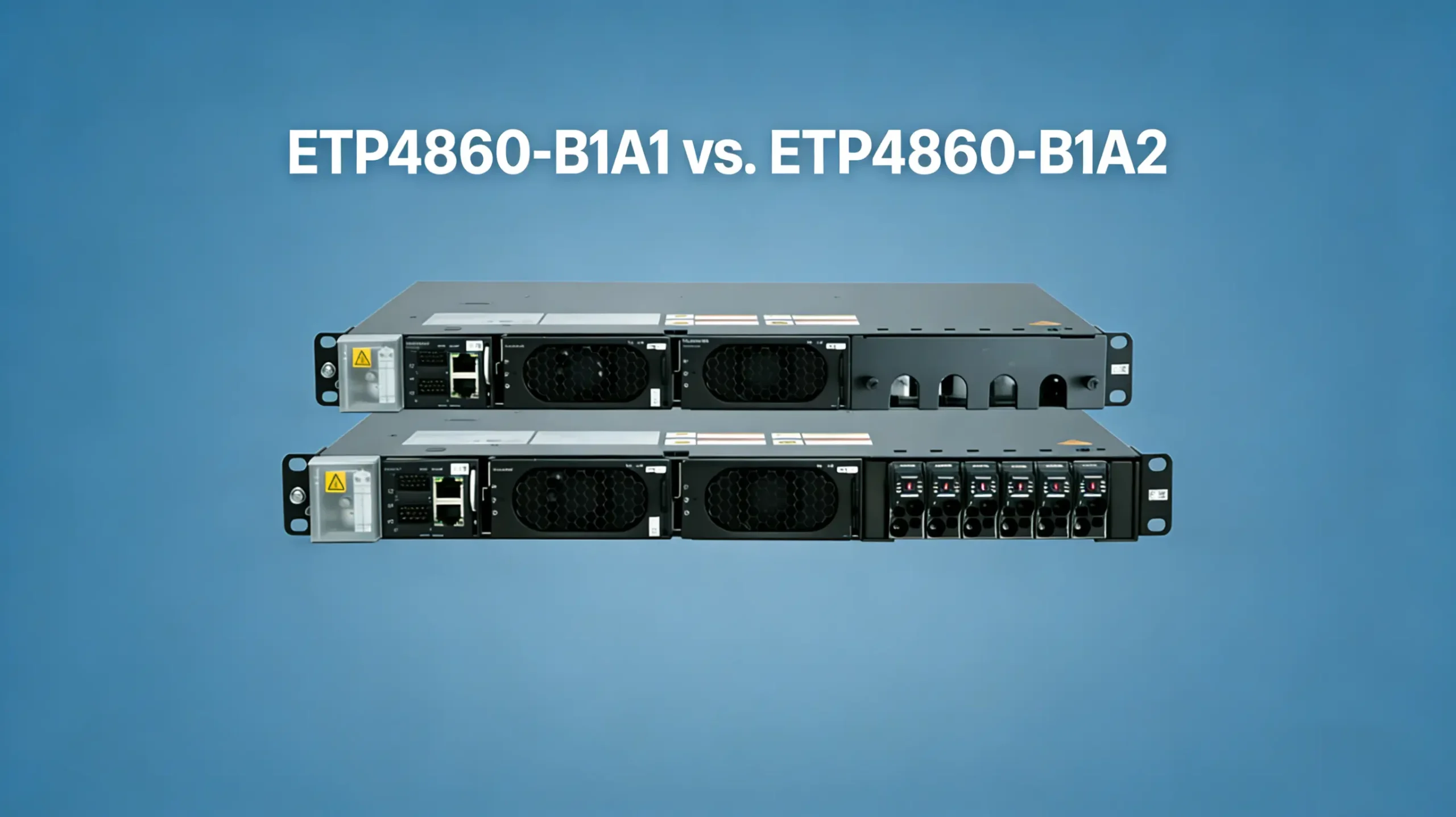
The primary difference lies in the DC Output Distribution (Load Ports) and the default Monitoring Units.
A. Load Distribution (The Main Divider)
The B1A2 is generally considered the “upgraded” or “expanded” version in terms of connectivity:
-
ETP4860-B1A1: Typically features 3 Load outputs and 1 Battery (BATT) port.
-
ETP4860-B1A2: Features 5 Load outputs and 1 Battery (BATT) port.
Why it matters: If you are powering multiple small devices (e.g., a router, a switch, and an OLT) from a single power box, the B1A2 provides more dedicated terminals, eliminating the need for external distribution strips.
B. Monitoring Modules: SMU11B vs. SMU11C
While both subracks can host either module, they are often bundled differently:
| Feature | SMU11B (Common in B1A2) | SMU11C (Common in B1A1) |
| Uplink Port | FE (Fast Ethernet) | RS485 |
| Management | WebUI, SNMP, HTTPS | LIVE-C APP (Bluetooth/WiFi) |
| LCD Display | No (Indicators only) | No (Indicators only) |
| Best For | Remote central management | Local mobile app management |
-
SMU11B is preferred for large-scale deployments where you need to monitor the power status via a browser (WebUI) or integrate it into a Network Management System (NMS).
-
SMU11C is more common in cost-sensitive or remote sites where engineers use a smartphone app for local maintenance via Bluetooth.
3. Technical Specifications Table
| Specification | ETP4860-B1A1 | ETP4860-B1A2 |
| Height | 1U | 1U |
| Max Capacity | 4kW (60A) | 4kW (60A) |
| DC Outputs | 3 (Typically 2x30A, 1x16A) | 5 (Typically 4x32A, 1x16A) |
| Battery Port | 1 x 50A | 1 x 50A |
| Default Monitor | SMU11C (Variable) | SMU11B (Variable) |
| Cooling | Natural Cooling (Subrack) | Natural Cooling (Subrack) |
| Input Voltage | 85V AC ~ 300V AC | 85V AC ~ 300V AC |
4. Selection Guide: Which one to buy?
Choose the ETP4860-B1A1 if:
-
You have a simple setup with only 1 or 2 devices to power.
-
You are looking for the most cost-effective solution.
-
Local maintenance via a mobile app (SMU11C) is sufficient for your team.
Choose the ETP4860-B1A2 if:
-
You need to connect more than 3 devices directly to the power system.
-
Remote Web Management is a requirement (using SMU11B’s FE port).
-
You are future-proofing a site that might grow in complexity.
Conclusion
Both the ETP4860-B1A1 and B1A2 are robust, carrier-grade power systems. The choice boils down to how many devices you need to plug in and how you want to monitor them. For most modern ISP setups, the B1A2 with SMU11B is the preferred choice due to its superior port density and remote Ethernet management.